
CONSULT / TECHNOLOGY DIRECTION
Decide what to improve, replace, or build next.
Start with the unresolved decision. Understand the organization, clarify the friction, and set a direction people can act on.
- UNCERTAINTY
- UNDERSTANDING
- OPTIONS
- DIRECTION
- MOMENTUM

- CURRENT STATE
- PRESSURES
- OPTIONS
- NEXT MOVE
DIRECTION BEFORE BUILD
Understand the organization. Clarify the decision. Then determine what to build next.
A focused Strategy Sprint begins with understanding, not a predetermined solution. It examines how the organization works, where products and workflows create friction, and what should change first.
ORGANIZATION
People, responsibilities, objectives, and constraints
PROCESS
How work moves, where it breaks, and who owns it
TECHNOLOGY
What should improve, connect, remain, or be built
CONVENTIONAL TECHNOLOGY CONSULTING
When the solution is selected before the organization is fully understood:
- Begins with a presumed platform, deliverable, or implementation
- Treats visible symptoms as separate technology problems
- Makes implementation the expected outcome
- Measures progress primarily by what gets launched
The risk: The organization receives a solution before the underlying decision is clear.
THE SHIFTUNDERSTAND BEFORE PRESCRIBING
THE AVENIER APPROACH
Begin with the unresolved decision and the organization responsible for carrying it forward:
- Examines people, ownership, workflows, systems, and constraints
- Compares improvement, connection, replacement, deferral, and build options
- Separates what must change now from what can wait
- Measures progress by whether the organization has a direction it can own and act on
The result: A defensible direction before implementation begins.
THE DIFFERENCE BEGINS WITH THE QUESTION
Select the pressure closest to your organization. See what Avenier would clarify and the direction that could follow.
DECISION DIAGNOSTIC
What is making the next move difficult?
Select the pressure
What Avenier clarifies
- Which decisions are actually connected
- What the organization must resolve first
- Which investments depend on other changes
- What can wait without creating additional risk
- Who owns the final decision
Define the direction
- CLARIFY NOW
- Dependencies, ownership, urgency, and evaluation criteria
- DECIDE NEXT
- Defer, sequence, combine, or stop
- PRESERVE FOR LATER
- Flexibility to phase investments as priorities and capacity change
- POSSIBLE DIRECTION
- A prioritized digital roadmap
- WHAT THIS MAKES POSSIBLE
- Leadership can fund the highest-value move without closing off responsible options.
This is not an automated recommendation. It shows the questions Avenier would investigate first.
Discuss this decisionCompeting priorities selected. Avenier clarifies 5 questions. Clarify now: Dependencies, ownership, urgency, and evaluation criteria. Decide next: Defer, sequence, combine, or stop. Preserve for later: Flexibility to phase investments as priorities and capacity change. Possible direction: A prioritized digital roadmap. Leadership can fund the highest-value move without closing off responsible options.
The goal is not to predict one fixed future.It is to make the organization ready for what comes next.
WHAT THE STRATEGY SPRINT DELIVERS
Direction is a deliverable.
A Strategy Sprint turns uncertainty into a responsible direction: examine the current environment, compare viable paths, and sequence the next move by value, risk, dependency, and capacity.

01 — ASSESS
What is happening now?
Examine people, workflows, systems, and constraints.
OUTPUTCurrent-environment view
02 — ALIGN
What must be decided?
Set priorities, ownership, criteria, and technical boundaries.
OUTPUTAgreed decision criteria
03 — RECOMMEND
What should happen next?
Compare viable directions and define the recommended course.
OUTPUTDefensible recommendation
04 — SEQUENCE
What should happen first?
Stage the work by value, risk, dependency, and capacity.
OUTPUTPrioritized roadmap
YOU LEAVE WITH
A defensible direction and a prioritized roadmap your organization can fund, own, and carry forward.
A FOCUSED FIRST ENGAGEMENT
Technology Direction can begin as a bounded Strategy Sprint centered on one unresolved decision. It produces decision criteria, a defensible recommendation, and a sequenced next move. Implementation can follow, but it is not assumed.
A STRATEGY SPRINT MAY BE USEFUL WHEN
- A major digital investment is being considered
- Priorities or decision criteria are unclear
- Leadership needs confidence before implementation
Start with the unresolved decision—not a predetermined project.
Discuss a Strategy SprintTHE RIGHT NEXT MOVE
Make the next decision without limiting the ones that follow.
Good technology direction does not assume the answer is something new. It finds the move that resolves today’s need while preserving the ability to adapt, connect, and grow.
The strongest decision creates progress now without closing off what becomes possible next.
CURRENT REALITY
Needs, constraints, responsibilities, dependencies, and capacity
- Value
- Risk
- Ownership
- Dependency
- Capacity
POSSIBLE MOVES
RESPONSIBLE DIRECTION
IMPROVE
Strengthen what already works.
- WHEN IT FITS
- The system is sound, but focused changes could reduce friction or improve accessibility, usability, or reliability.
- WHAT IT PROTECTS
- Existing investment, knowledge, and continuity.
- WHAT IT MAKES POSSIBLE
- A stronger foundation that keeps evolving without unnecessary replacement.
Illustrative directions—not a recommendation for your organization.
Improve selected. Strengthen what already works.
HOW DIRECTION BECOMES SPECIFIC
Three scenarios. Three different recommendations.
ORGANIZATIONAL PRESSURE
Different audiences need different things from the digital experience.
THE UNRESOLVED DECISION
Whether to build, who it should serve, and what it should accomplish first.
WHAT CONSTRAINS IT
Current tools and audiences pull in different directions.
OPTIONS CONSIDERED
RECOMMENDED DIRECTION
A first release that serves both audiences without replacing the public site.
WHY THIS DIRECTION
Creates progress now, keeps the public site, and avoids a premature platform commitment.
WHAT HAPPENS NEXT
Sequence that first release so the organization can fund it.
ILLUSTRATIVE AVENIER LAB SCENARIOS
Independently developed demonstrations of Avenier’s decision approach. They do not represent commissioned client work or reported client results.
Digital Product Direction selected. Recommended direction: A first release that serves both audiences without replacing the public site.
AVENIER LAB · CONCEPT STUDY
Before an interface was designed, the service had to be understood.
The Briarfield concept study starts with a resident need, then clarifies ownership, accessibility, system boundaries, and implementation order before defining the digital response.
WHAT THE DIRECTION MADE POSSIBLE
A resident-centered website and service response built around ownership, accessibility, and an actionable sequence.
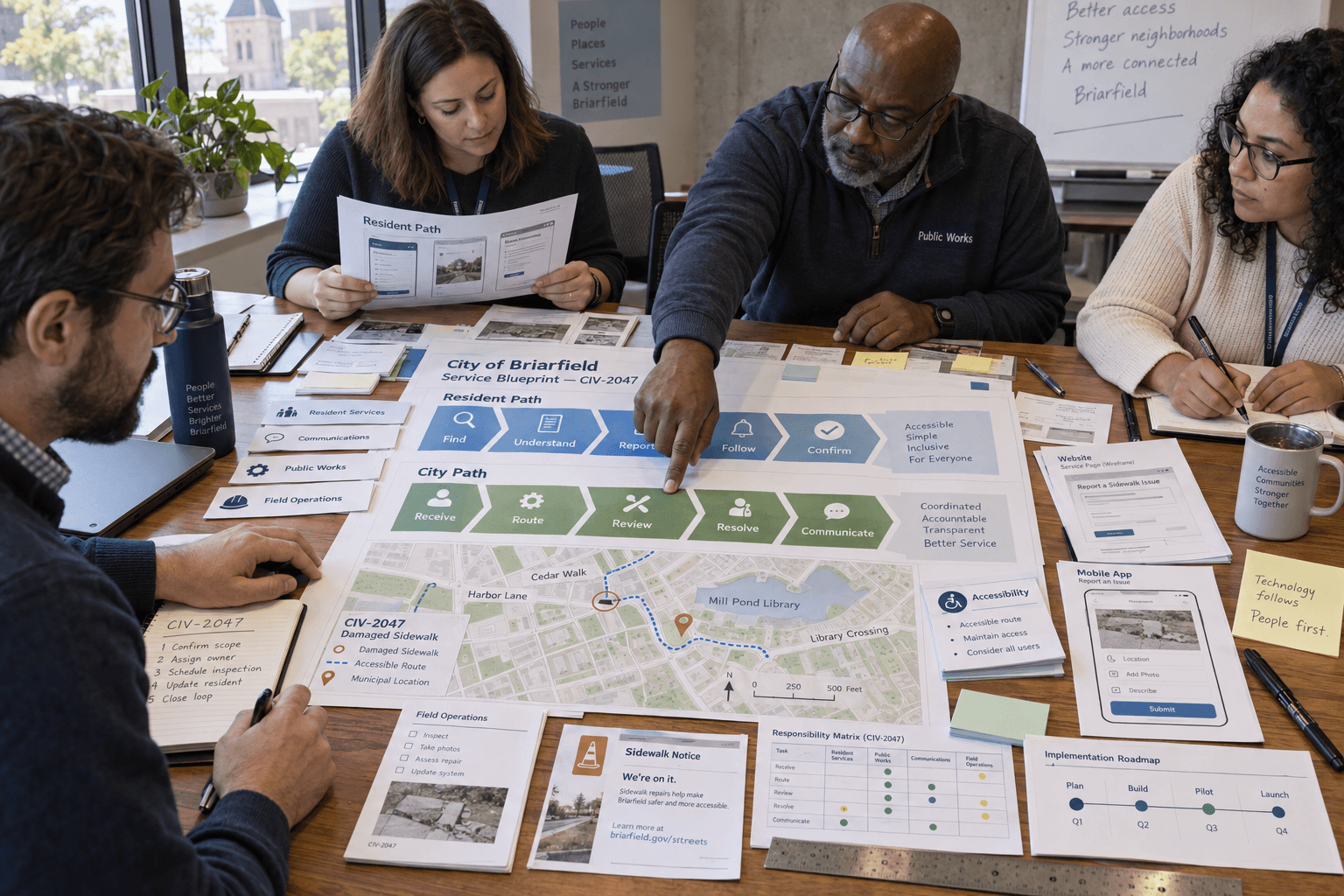
INDEPENDENT AVENIER LAB CONCEPT STUDY
Avenier Lab concept studies are independently created to demonstrate our approach. They are not commissioned client work or reported client results.
01 — UNDERSTAND THE NEED
Resident experience and accessibility
Start with what the resident is trying to do and where the service creates uncertainty or exclusion.
02 — CLARIFY THE SERVICE
Ownership, responsibilities, and boundaries
Define who owns the response and where digital tools should support it.
03 — SEQUENCE THE RESPONSE
What should happen first and why
Turn the direction into an order the organization can carry forward.
A PRACTICAL FUTURE STARTS WITH A CLEAR DECISION
Make the next decision with the future still open.
Bring us the uncertainty, competing priorities, or investment under consideration. We’ll clarify what matters now, compare responsible directions, and define a next move that keeps later options open.
- UNDERSTAND WHAT’S CHANGING
- COMPARE RESPONSIBLE DIRECTIONS
- MOVE FORWARD WITH CLARITY
- No prepared technical brief required
- No predetermined solution
- More than one direction can be considered
- Implementation is available—never assumed