

Avenier Lab / Municipal Concept Study
City of Briarfield
What if one resident request could stay connected from first report to final resolution?
A concept study exploring how direction, digital services, operational software, and communication could work together around one municipal service experience.
Independent concept study · Fictional municipality
PracticesTechnology DirectionWebsite DevelopmentCustom Software DevelopmentCommunications Design
Explore the studyCIV-2047 · Cedar Walk
- Resident need
- Place
- Work
- People
- Communication
- Resolution
- Resident need
- Connected city work
- Resolution
The situation
One damaged sidewalk. One resident trying to get help.
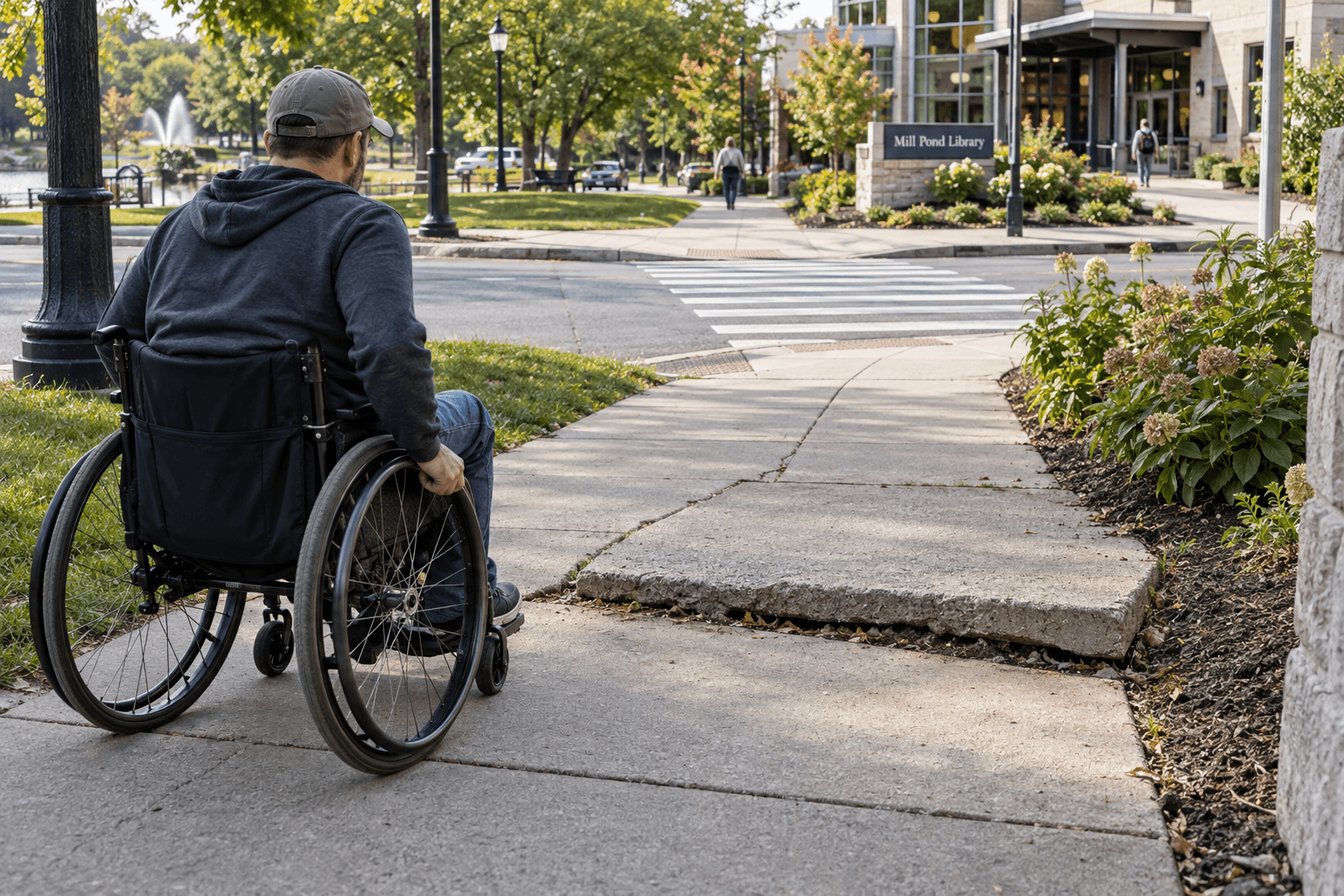
A resident sees a damaged sidewalk creating an accessibility concern at Cedar Walk at Harbor Lane, west of the Mill Pond Library crossing. Inside the city, the same request could belong to streets, public works, accessibility, or parks. This concept follows request CIV-2047 end to end.
Where do I start?
A broken sidewalk might involve streets, public works, accessibility, parks, or another department. Residents should not need to understand the city’s organizational chart before asking for help.
How do I identify the location?
A street address may not be enough. Residents need a way to identify a landmark, map point, crossing, or nearby public place.
What happens after I report it?
Submitting a form should not end the experience. Residents need understandable confirmation, status information, and closure.
Behind the concept
A concept is a starting point.Validation shapes what gets built.
Briarfield is fictional. The interfaces and workflows below demonstrate how Avenier might approach a municipal technology environment — not assumptions we would carry directly into a real engagement.
- 01AssumeCreate a plausible starting point.
- 02ValidateLearn how people, processes, and systems actually work.
- 03AdaptChange the direction based on what we learn.
The connected idea
One request, followed through every practice.
This is not four unrelated services. They are four views of one organizational challenge, followed here through request CIV-2047.
- CIV-2047
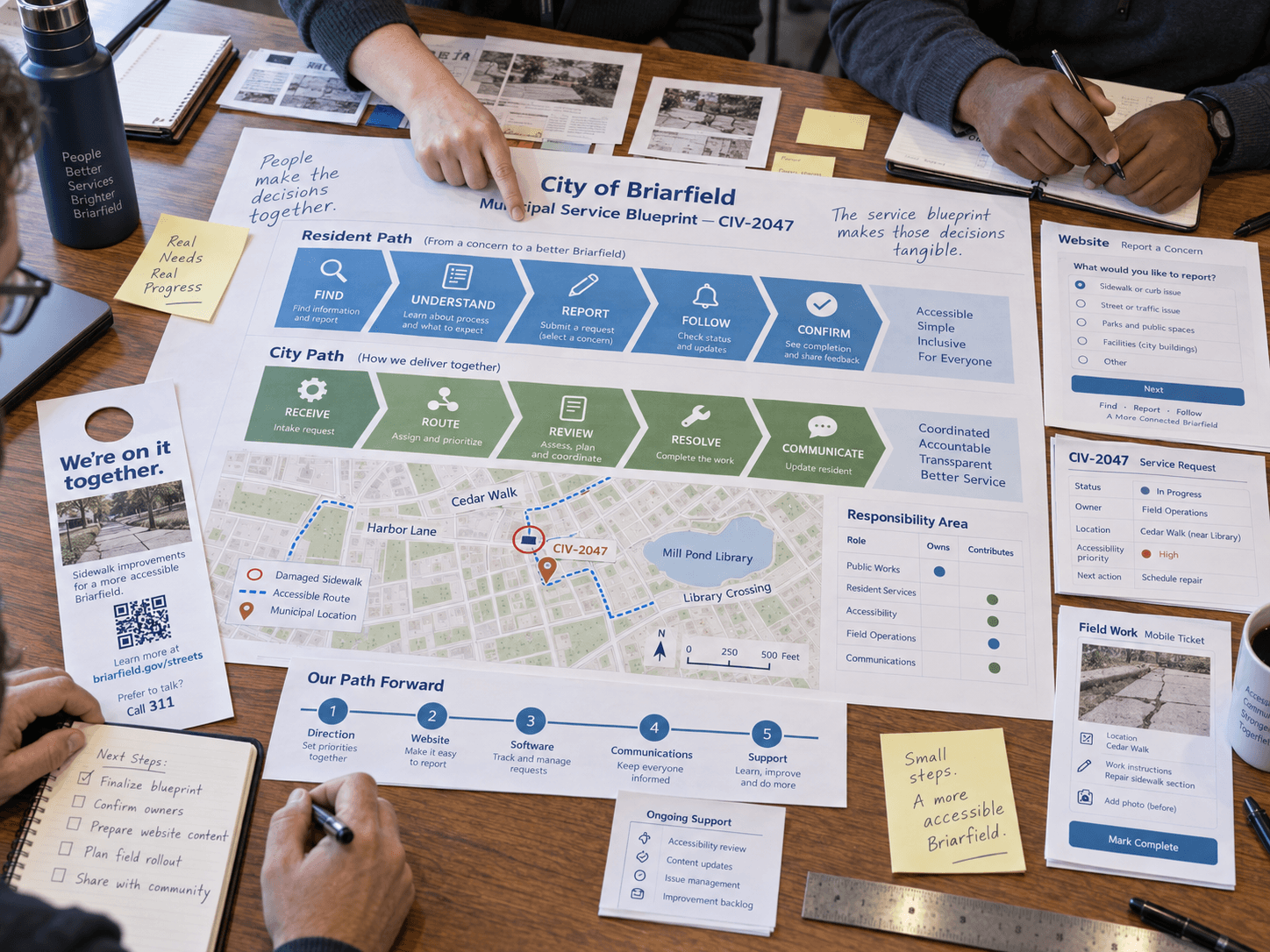 01Technology direction
 - CIV-2047
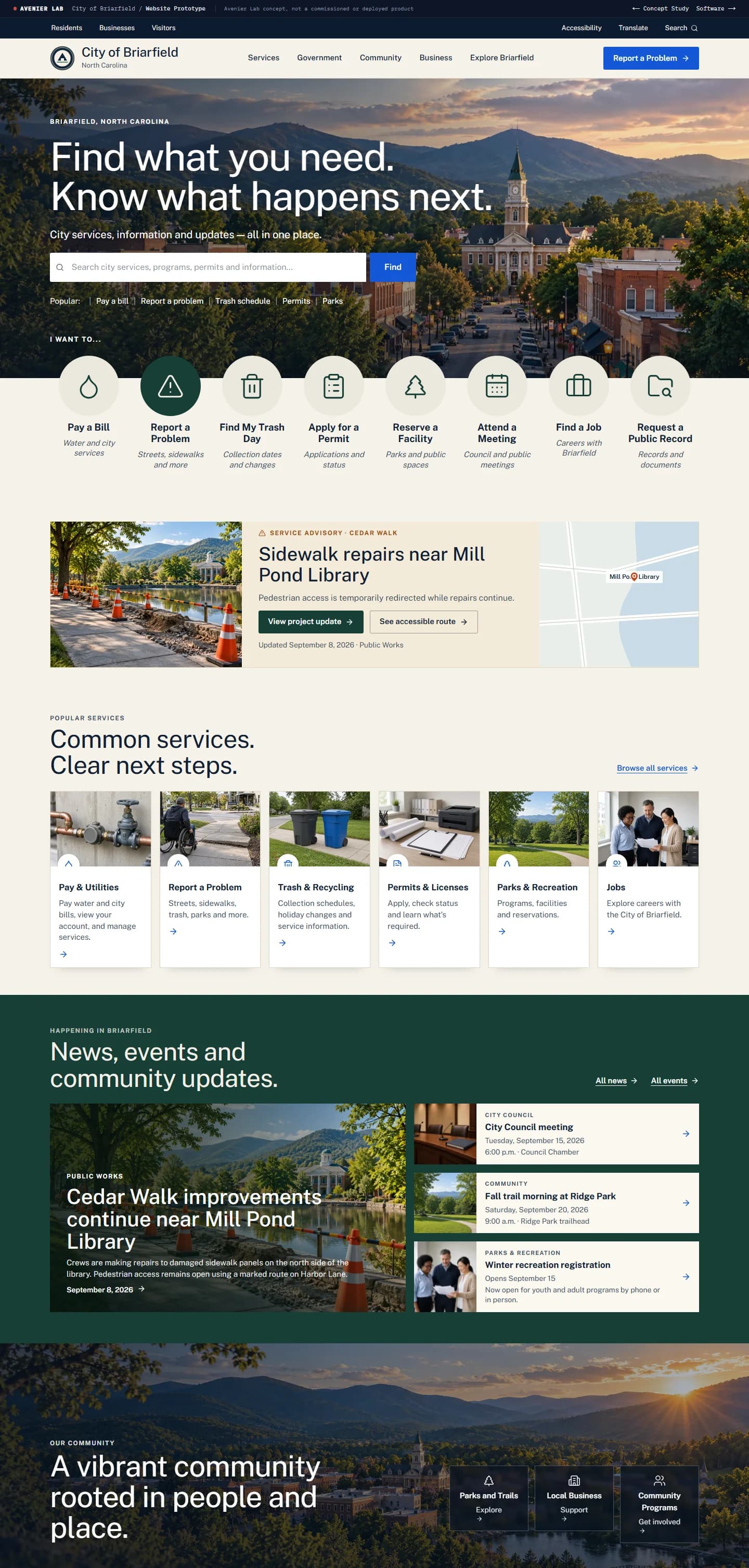 02Resident website
 - CIV-2047
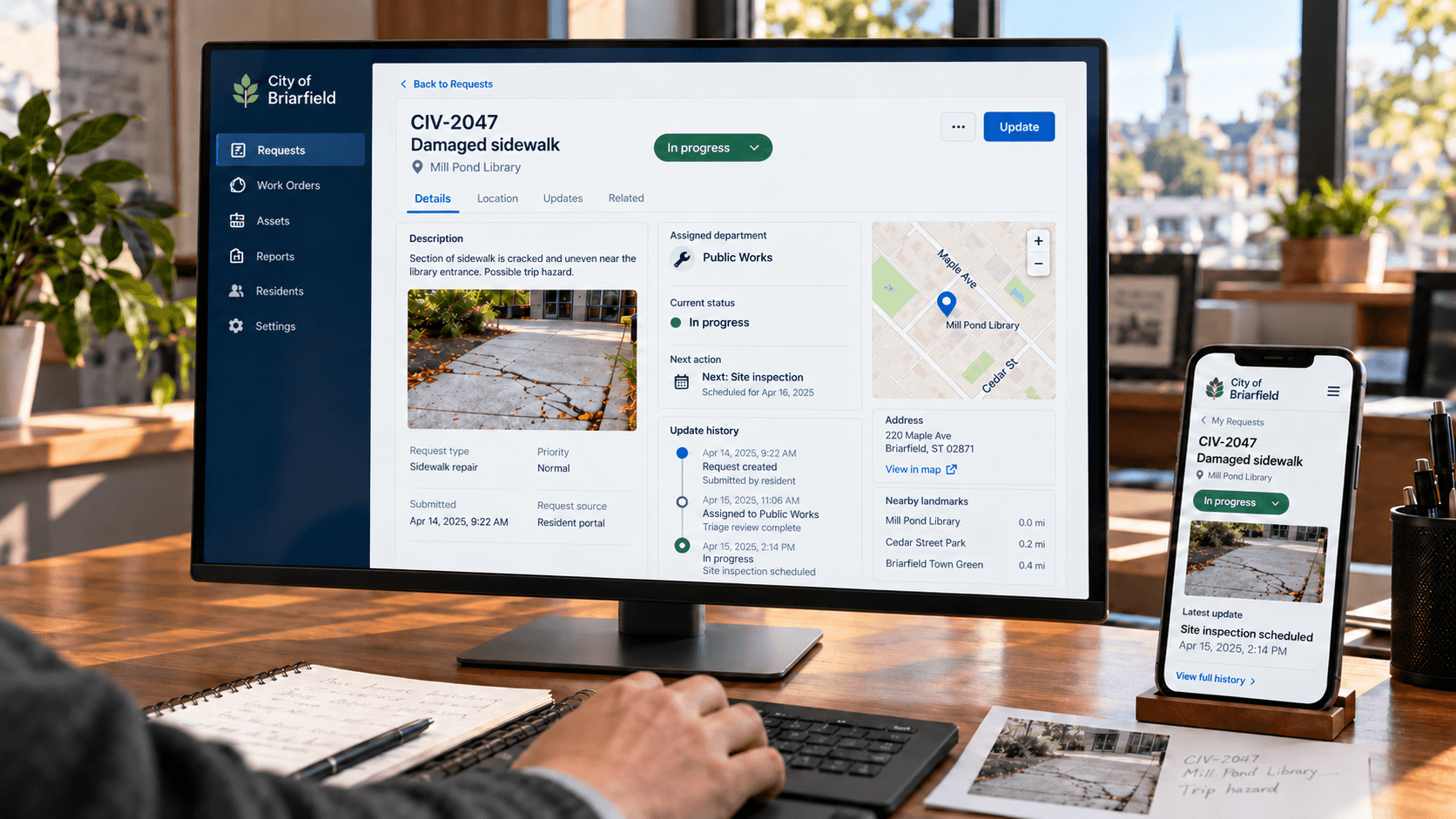 03Briarfield Connect
 - CIV-2047
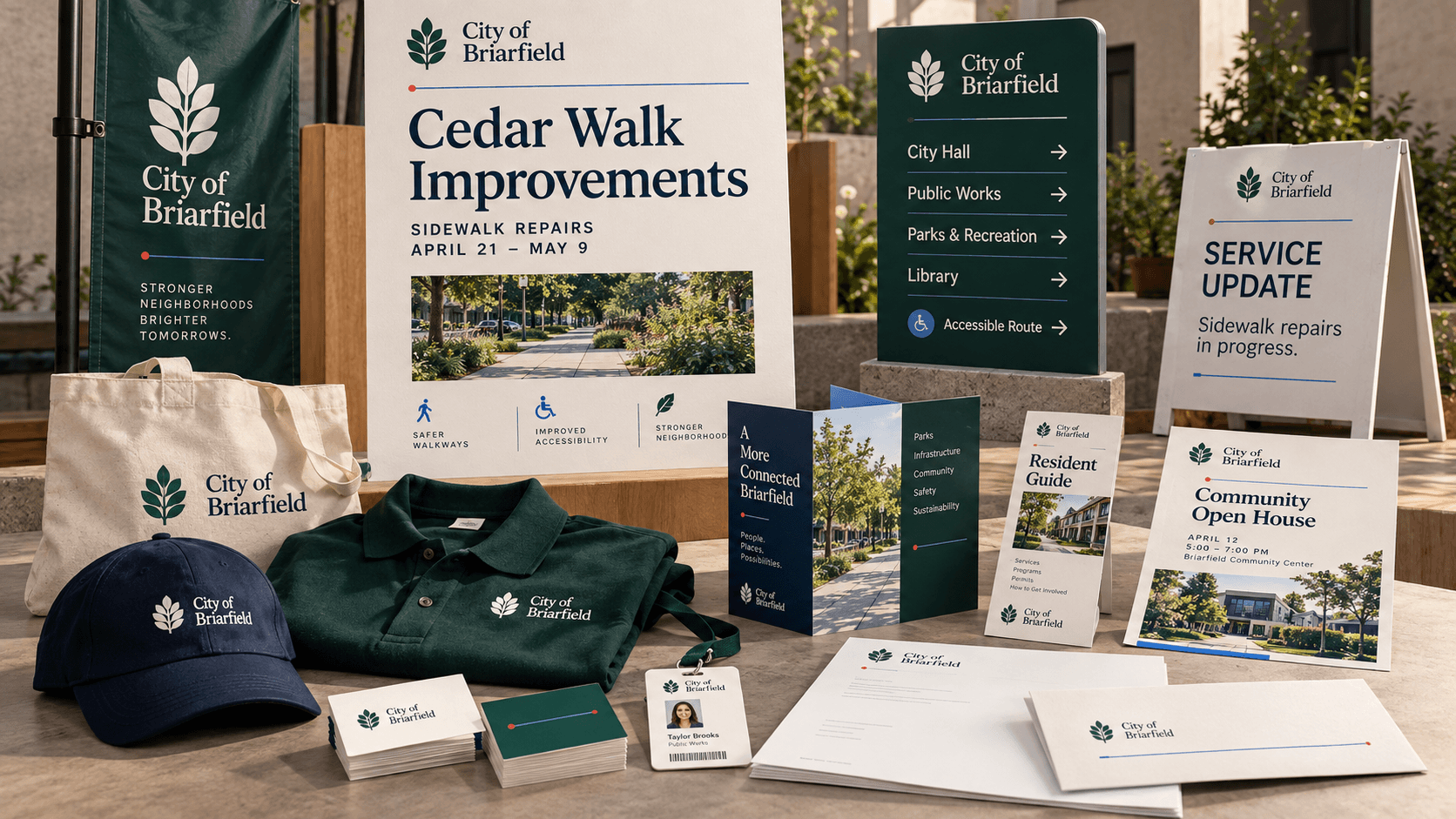 04Communications Design
01— TECHNOLOGY DIRECTION
See what you have. Understand what connects. Decide what comes next.
We map the systems, dependencies, constraints, and opportunities shaping the organization—then turn them into priorities and a practical technology roadmap.

City of Briarfield
Technology Direction Map
Independent concept study · illustrative examples
- 01Current environment
- 02Pressures & gaps
- 03Direction decisions
- 04Priorities
- 05Roadmap
01 · UnderstandCurrent environment
02 · EvaluatePressures & gaps
03 · DecideDirection decisions
Working assumptions · concept study
- Public websiteCitizen information, forms, accessibility
- Internal applicationsDepartment workflows and operational tools
- Data & reportingDepartment data, reporting, exports
- Infrastructure / cloudHosting, identity, storage, network dependencies
- CybersecurityAccess, backups, security practices
- CommunicationsEmail, public notices, alerts, digital communications
- Support & vendorsExternal providers, contracts, internal ownership
- Accessibility remediation already planned
- Do we actually need to replace this?
- No internal system owner
- Duplicate entry between applications and reporting
- Two departments depend on this
- FY27 budget cycle
- Security review required
- KeepExisting finance platformStable, supported, and meeting current needs.Internal applicationsNo change recommended.
- ImprovePriority 01Public websiteAccessibility, governance, and maintainabilityPublic website
- ConnectPriority 02Service requests + reportingReduce duplicate entry and improve visibilityInternal applications · Data & reporting
- ReplacePriority 03Legacy internal workflowHigh maintenance and limited visibilityInternal applications
- ExplorePriority 04Shared data layerValidate value before investingData & reporting · InfrastructureNot yet.
Not everythingneeds to be replaced.
SequencePriorities
- 01ImprovePublic website
- 02ConnectService requests + reporting
- 03ReplaceLegacy internal workflow
- 04ExploreShared data layer
- —KeepExisting finance platform
- Priority 01
- Near-term
- Priority 02–03
- Sequenced next
- Priority 04
- Validate before investing
- Unnumbered
- Maintain / monitor
RoadmapIllustrative horizons
- Now0–3 monthsStabilize
- Document current environment
- Resolve immediate risks
- Confirm ownership
- Next3–9 monthsModernize what matters
- Website modernization01
- Accessibility improvements01
- Priority integrations02
- Later9–18 monthsImprove the core
- Internal workflow modernization03
- Data/reporting improvements
- Selective automation
- Future18+ months / revisitStay adaptable
- Evaluate shared data layer04
- Revisit architecture
- Adjust roadmap as conditions change
Direction, not a rigid plan: revisit as needs, budgets, and technology change.
City of Briarfield · Technology Direction Map · Independent concept study · illustrative examples
01 Current environment
- Public websiteCitizen information, forms, accessibility
- Internal applicationsDepartment workflows and operational tools
- Data & reportingDepartment data, reporting, exports
- Infrastructure / cloudHosting, identity, storage, network dependencies
- CybersecurityAccess, backups, security practices
- CommunicationsEmail, public notices, alerts, digital communications
- Support & vendorsExternal providers, contracts, internal ownership
02 Pressures & dependencies
- Website forms feed the service requests handled in internal applications.
- Reporting depends on what internal applications record.
- Hosting and identity sit underneath internal applications.
- Security practices depend on the infrastructure beneath them.
- A shared data layer would build on reporting. Its value is still to be validated.
- Accessibility remediation already planned
- Do we actually need to replace this?
- No internal system owner
- Duplicate entry between applications and reporting
- Two departments depend on this
- FY27 budget cycle
- Security review required
Working assumptions · concept study
03 Direction decisions
- KeepExisting finance platformStable, supported, and meeting current needs.Internal applicationsNo change recommended.
- ImprovePriority 01Public websiteAccessibility, governance, and maintainabilityPublic website
- ConnectPriority 02Service requests + reportingReduce duplicate entry and improve visibilityInternal applications · Data & reporting
- ReplacePriority 03Legacy internal workflowHigh maintenance and limited visibilityInternal applications
- ExplorePriority 04Shared data layerValidate value before investingData & reporting · InfrastructureNot yet.
Not everything needs to be replaced.
04 Priorities
- 01ImprovePublic website
- 02ConnectService requests + reporting
- 03ReplaceLegacy internal workflow
- 04ExploreShared data layer
- —KeepExisting finance platform
- Priority 01
- Near-term
- Priority 02–03
- Sequenced next
- Priority 04
- Validate before investing
- Unnumbered
- Maintain / monitor
05 Roadmap
Illustrative horizons
- Now0–3 monthsStabilize
- Document current environment
- Resolve immediate risks
- Confirm ownership
- Next3–9 monthsModernize what matters
- Website modernization01
- Accessibility improvements01
- Priority integrations02
- Later9–18 monthsImprove the core
- Internal workflow modernization03
- Data/reporting improvements
- Selective automation
- Future18+ months / revisitStay adaptable
- Evaluate shared data layer04
- Revisit architecture
- Adjust roadmap as conditions change
Direction, not a rigid plan: revisit as needs, budgets, and technology change.
How Avenier thinks
Understand before recommending.
Useful direction starts with understanding the organization around the technology, not just the technology itself.
- 01UnderstandWhat exists today?
- Technology
- People
- Process
- Dependencies
- 02TestWhat shapes what’s possible?
- Constraints
- Readiness
- Risk
- Capacity
- 03DirectWhat paths make sense?
- Improve
- Connect
- Replace
- Explore
- Keep
Possible outputs Current-state map · Decision framework · Priority roadmap
From direction to experience
We understand the direction.Now let’s see what that direction could become.
02— WEBSITE DEVELOPMENT
A resident experience built around getting things done.
Residents think in needs, places, and outcomes — not departments.
A municipal website should help people start with what they need to accomplish, then guide them to the right service.
Briarfield
My Requests
CIV-2047
Damaged sidewalk
Mill Pond Library
In progress
Latest update
Site inspection scheduled
Apr 15, 2025, 2:14 PM
View full history
- Find
- Inform
- Follow
CIV-2047Resident journey
The question
Should residents need to understand city departments before they can ask for help?
The direction
Organize around what residents are trying to accomplish — not the municipal org chart.
The experience
- 01 — Find
Start with the need, not the department.
Residents shouldn’t need to understand the organizational chart to get help.
- Plain-language services
- Location-aware guidance
- 02 — Understand
Know what’s needed before submitting.
Clear requirements reduce incomplete requests and unnecessary back-and-forth.
- Eligibility & requirements
- Accessible, mobile-first forms
- 03 — Follow
See what happens after submit.
Status, expectations, and updates make government services feel less opaque.
- Visible status
- Next-step expectations
Possible outputs Information architecture · Accessible experience · Production website
03 — CUSTOM SOFTWARE DEVELOPMENT
How Avenier thinks / Software development
Software should follow the work.
We start with the people doing the work, understand how information and responsibility move, and design the system around that reality — not the other way around.
- 01Understand the work
- 02Connect the record
- 03Design for reality
- 04Adapt over time
01Understand the work
One request. One connected operational record.
The problem
Requests move between teams.Context often doesn’t.
Information can fragment across email, spreadsheets, departments, and disconnected systems as responsibility changes.
The principle
Move ownership —not the record.
Keep the request, history, responsibility, status, and next action connected as work moves across the organization.
02Connect the record
Request lifecycle CIV-2047
Staff workspaceFull operational context.
Damaged sidewalk creating an accessibility concern
Cedar Walk at Harbor Lane · North curb · panel 14
- ReceivedResident Services. Resident Services receives the report and keeps the wording intact.
The request moves to the team that can assess it.
Field viewSame record. Only what’s needed here.
The record stays intactas responsibility moves.
Ownership can change without forcing the next person or team to reconstruct what already happened.
Explore Briarfield ConnectThe next question
But what happenswhen the expected path changes?
03Design for reality
Beyond the happy path
Real operationsaren’t always linear.
The system has to keep context intact when the expected path changes.
01 Exception
What happens when the request doesn’t fit the normal path?
Preserve the original context while allowing staff to clarify, reroute, or escalate without blocking access to help.
02 Handoff
What happens when responsibility changes?
Move ownership without moving the record, or forcing the next team to reconstruct what already happened.
03 Ongoing support
What happens after launch?
Maintain the system as workflows, policies, accessibility requirements, integrations, and organizational needs change.
Design for what happensbetween the steps —not only the happy path.
Useful software has to account for exceptions, handoffs, changing responsibilities, and what happens after launch.
Different responsibilitiesdon’t require differentsources of truth.
04Adapt over time
The software principle
One systemis notOne interface
One source of truth.Different views for different responsibilities.
Staff, field teams, leadership, and residents don’t need the same interface. They need the same information to remain connected.
Shared record / purpose-built views
- Resident
- Staff
- Field team
- Leadership
How Avenier thinks
Understand the work.Preserve the context.Build around reality.
- People
- Organization
- Process
- Technology
Technology comes last for a reason. The system should reflect how people, responsibilities, decisions, and information actually move through the organization.
Possible outputs Workflow model · Connected application · Operational system
04 — COMMUNICATIONS DESIGN
Clear communication beyond the interface.
A service doesn’t stop at the screen. We carry its language and priorities across notices, signs, guides, events, staff communications, and other real-world touchpoints — so each moment feels connected to the same service.
Avenier Lab · Independent concept study
How Avenier thinks / Communications design
01 — Establish the message
Same information.
Avenier identifies what people need to know and what action the communication needs to support.
02 — Design for the moment
Different context.
We adapt the hierarchy, format, and level of detail to where and how people encounter it.
03 — Keep the path clear
One clear next step.→
Across notices, signs, guides, events, and digital touchpoints, the next action stays easy to understand.
Communication system / Cedar Walk
One service expressed across the moments surrounding it.
- 01 — Public informationWhat is changing?
- 02 — WayfindingWhere do I go?
- 03 — Service materialsWhat do I need to know?
- 04 — Organizational touchpointsWho is communicating with me?
The outcome
The goal is less friction.
Different formats, one coherent path from information to action.
Possible outputs Communication system · Production-ready materials · Real-world touchpoints
One connected service
One request.One status.Every channel.
- Resident websiteCIV-2047Field work scheduled
- Briarfield ConnectCIV-2047Field work scheduled
- Field communicationCIV-2047Field work scheduled
- Resident communicationCIV-2047Field work scheduled
Request CIV-2047 shown as "Field work scheduled" on the resident website, in Briarfield Connect, in field communication, and in resident communication: one record and one status, seen through four channels.
Behind the concept / Validation notes
What the concept assumes.What we’d need to learn.
The study gives us plausible directions to explore. A real engagement would test those ideas against the people, processes, systems, and constraints already in place.
Avenier Lab
Validation notes / City of Briarfield
01 — Service discovery
Assumption
Residents can begin with a shared service entry point.
Validation questions
- How do residents actually find and request services today?
- Where do requests actually enter the organization?
- What channels are most important to residents?
Design implicationResident need ≠ internal workflow
02 — Shared record
Assumption
CIV-2047 can move between departments as one connected service record.
Validation questions
- Which systems are authoritative today?
- Where is information re-entered?
- When does ownership actually change?
- Which integrations would be required?
Design implicationExisting systems matter
03 — Shared language
Assumption
A common service-status vocabulary can work across resident and staff touchpoints.
Validation questions
- What terminology do staff use today?
- What do residents actually need to know about status?
- Where do department vocabularies differ?
- What language needs to remain specific to a particular service?
04 — Field experience
Assumption
Field staff can use a reduced view of the same underlying record.
Validation questions
- What information do field teams actually need?
- What can safely be omitted?
- What accessibility requirements apply?
- What connectivity conditions exist in the field?
- What security, privacy, records, and audit requirements affect the experience?
Design implicationAccessibility is a requirement
What we’d measure
Time to route · Duplicate entry · Handoffs · Resident follow-up · Accessibility failures · Resolution visibility
If this were your organization
The concept changes.The way we work doesn’t.
- 01UnderstandMap the environment, people, processes, systems, and constraints.
- 02DecideDetermine what deserves attention, what can wait, and what direction makes sense.
- 03BuildDesign and implement the right next move.
- 04SupportKeep improving as needs, systems, and conditions change.
The exact engagement depends on what discovery reveals.
Your organization won’t look like Briarfield.
That’s the point.
We start by understanding how your people, processes, communications, and technology actually work — then determine what deserves to change.