

Avenier Group

Strategic Technology Leadership

Turn complexity into clear direction.

A technology direction your board can actually defend — with senior counsel that stays invested as decisions become delivery.

You should not have to carry every technology decision alone.

We need clearer technology decisions without another abstract roadmap.

Leadership meetings keep circling the same technology questions without landing on a decision, because no one owns the tradeoffs between competing priorities.

The underlying issue usually isn’t a lack of options — it’s a lack of a single, trusted way to weigh them. A roadmap that isn’t tied to real decision-making authority just becomes another document nobody follows.

The more useful question isn’t “what should we build next,” but “who is actually accountable for sequencing what we build.”

The Avenier perspective

Software is rarely the first decision. It is usually the first visible one.

Decide the organization’s priorities first. Align the people who must own them. Clarify how the work actually happens. Only then choose technology — so the platform confirms decisions instead of forcing them.

  1. Organization

    What are we trying to accomplish?

  2. People

    Who owns the decision and the work?

  3. Process

    How should the work actually happen?

  4. Technology

    What should support it?

Executive needs

What changes when leadership no longer carries it alone.

  • When technology decisions keep stalling

    Priorities compete, options multiply, and leadership cannot land a sequence that feels defensible.

    What becomes possible

    A clear decision path — with ownership, tradeoffs, and a board-ready rationale that does not evaporate after the meeting.

  • When systems no longer support the organization

    Tools that once worked now create friction as responsibility, volume, and coordination have outgrown them.

    What becomes possible

    A practical view of what to keep, what to change, and what to stop — sequenced against real capacity.

  • When leadership lacks visibility

    Risk, initiative status, and technology spend are harder to see than they should be for the people accountable for them.

    What becomes possible

    Executive-level visibility that connects priorities, ownership, and progress without another unused dashboard.

  • When responsibility has outgrown internal capacity

    There is no senior technology leader available to connect mission, operations, and technical decisions day to day.

    What becomes possible

    Ongoing fractional CIO/CTO counsel that stays close to the work — an invested partner, not a temporary advisor.

Featured framework

The Avenier Organizational Readiness Framework

Questions asked in this order, before a single vendor conversation happens.

Technology initiatives disappoint when organizations choose platforms before aligning purpose, people, and process.

  1. Purpose

    What are we actually trying to achieve?

    Not the department’s stated goal. The organization’s actual goal — specific enough that finance, frontline staff, and the board mean the same thing.

  2. People

    Who is responsible, and who is affected?

    Every initiative has an owner on paper. Fewer have one in practice — someone accountable for adoption, training, and the resistance that shows up in month three.

  3. Process

    How does the work actually happen today?

    Not how it’s documented. How it happens — including the three unofficial versions of the “same” process that surface the moment a new system is configured.

  4. Technology

    What tool best supports the above?

    Asked this late, the technology conversation is usually shorter. Most of the hard thinking is already done.

When to useBefore evaluating vendors, approving a major technology investment, or restarting a stalled initiative.

When not to useAs a substitute for delivery work once purpose, ownership, and process are already clear and shared.

Founder and Managing Partner working with two organizational leaders around printed technology strategy materials.

Leadership partnership

Senior leadership stays involved.

Strategic technology leadership stays with Avenier’s Founder & Managing Partner — senior attention remains close to the advisory relationship, not handed off after the roadmap is written.

Founder & Managing Partner

Senior leadership remains close to the work—from the first conversation through the decisions that follow.

How Avenier helps

Clear decisions. Shared accountability.

Support organized around the situations leaders face — not a catalog of everything that could be sold.

  • Executive Advisory

    When leadership needs senior technology judgment without adding another full-time executive.

    • Ongoing senior technology counsel
    • Executive decision support
    • Leadership and board communication
  • Technology Strategy

    When priorities, investments, and systems need one coherent direction.

    • Current-state assessment
    • Strategic roadmap development
    • Investment prioritization
  • Organizational Alignment

    When teams, vendors, and leaders need shared priorities and clearer ownership.

    • Mission and technology alignment
    • Stakeholder alignment
    • Decision ownership
  • Executive Visibility

    When leaders need to see which risks, initiatives, and decisions require attention.

    • Risk visibility
    • Initiative oversight
    • Leadership-level recommendations

Engagement approach

Understand first. Decide once.

Strategic Technology Leadership applies Avenier’s operating model — Understand, Align, Execute, Support — as an ongoing partnership, not a one-time planning exercise.

  1. Understand

    See the organization clearly — purpose, people, process, capacity, and risk — before recommending change.

  2. Align

    Connect leadership priorities, ownership, and sequence so decisions can be defended and followed.

  3. Execute

    Turn direction into practical work while remaining close to accountability as delivery begins.

  4. Support

    Stay invested as conditions change — so momentum does not stop when the initial recommendations are complete.

Delivery discipline

Strategy stays connected to the work.

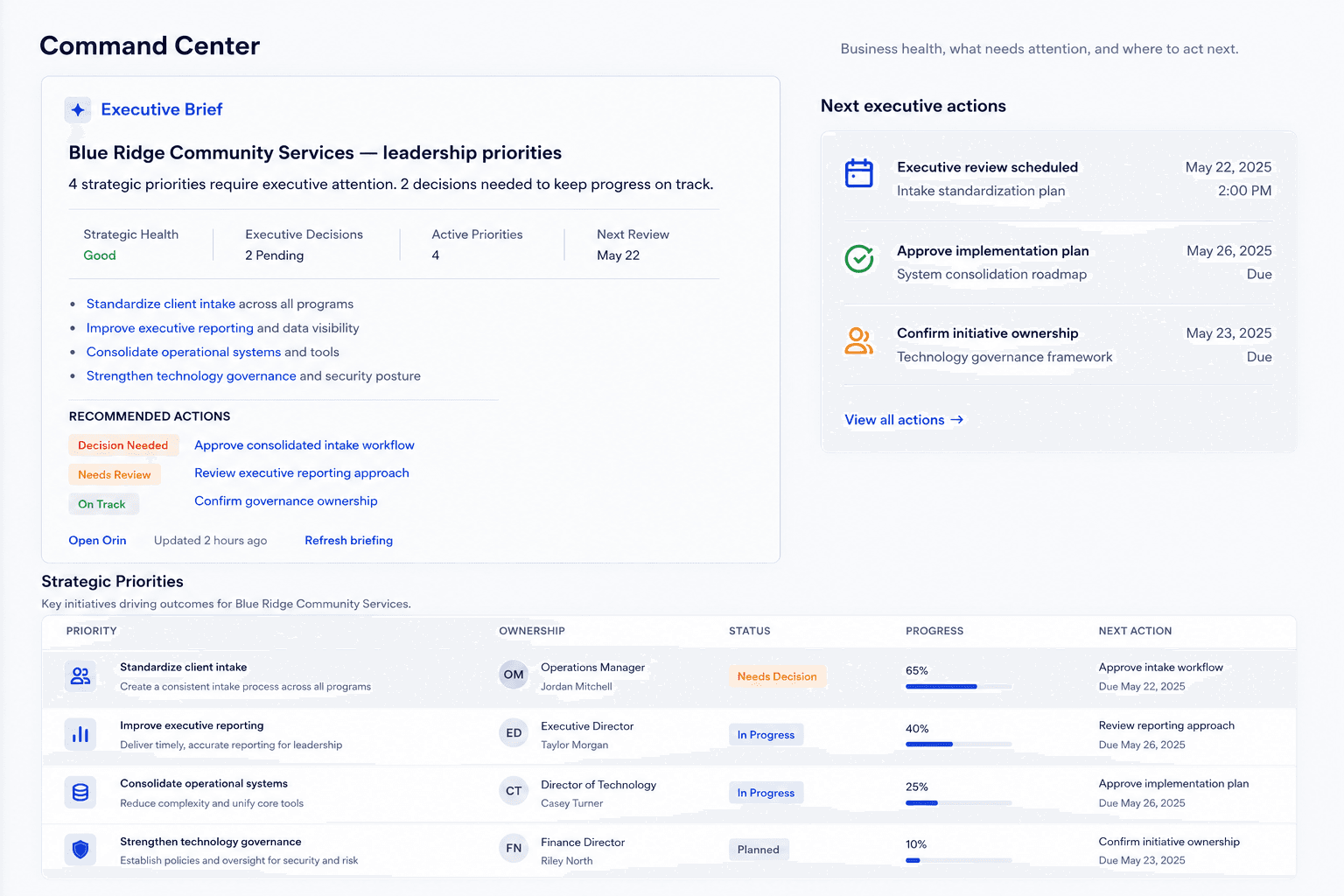
Every engagement is supported by Beacon, Avenier’s internal system for keeping priorities, executive decisions, ownership, and progress visible from planning through follow-through.

  1. Priorities
  2. Decisions
  3. Ownership
  4. Progress
Beacon executive command center showing leadership priorities, executive actions, ownership, status, progress, and next steps for a fictional organization.

Ready to move with more clarity?

Begin a conversation about Strategic Technology Leadership — as an invested partner for the decisions ahead, not a temporary advisor.

Start a Conversation