

Avenier Group

Software Development & Automation

Your team should not have to work around its technology.

Custom systems, workflow automation, and systems integration that make day-to-day operations more dependable — built around how your organization actually works.

Most software requests begin as organizational problems.

We're stitching together spreadsheets and hoping it holds.

Workflows evolved one exception at a time. Ownership became unclear. Systems stopped communicating. Manual work accumulated until a few people became the only ones who understood how everything fit together.

Every workaround made sense when it was built. Over time, operational complexity outgrew the original tools — and the organization is left holding the seams together.

The more useful question is rarely which platform to buy next. It is which step, if clarified and owned first, would free the most capacity without forcing the organization into software it cannot sustain.

Practice perspective

Automating a broken handoff just makes the breakage faster.

Simplify the work that no longer needs to exist. Connect the systems that should already agree. Automate what can happen consistently. Build only what genuinely requires a custom application.

  1. Simplify

    What unnecessary complexity can be removed?

  2. Connect

    Which existing systems and information should work together?

  3. Automate

    Which repeatable work should happen consistently?

  4. Build

    What genuinely requires a custom application?

What better systems make possible

From friction to dependable operation.

Useful software changes the state of the work — not just the tools on someone’s desk.

  • Manual effort

    Capacity restored

    Teams recover time for judgment and mission work instead of re-entering the same information.

  • Duplicate entry

    Connected information

    Shared definitions and dependable handoffs so people trust what they see without rebuilding it by hand.

  • Hidden responsibility

    Clear ownership

    Named owners for decisions, exceptions, and follow-through—visible to everyone who depends on them.

  • Fragile workarounds

    Dependable operations

    Purpose-built workflows replace informal fixes with systems the organization can understand, maintain, and improve.

Featured framework

The Connected Organization Model

A diagnostic for the three kinds of disconnect that stop software from improving how work actually gets done.

Organizations often integrate systems and still watch work stall — because information, process, and accountability are not the same problem.

  1. Information

    Is the data trusted, current, and shared?

    Integration can fix data that exists somewhere but is not trusted, current, or shared. This is the disconnect software is genuinely good at solving.

  2. Process

    Does work follow one agreed path?

    When teams perform the same work differently, integration does not fix the inconsistency — it moves it faster. Agree on the path before automating it.

  3. Accountability

    Who owns the decision and the follow-through?

    Visibility is not ownership. Decisions and exceptions need a single accountable owner, or connected systems still stall between people.

When to useWhen systems already exchange data but handoffs still stall, ownership is unclear, or automation keeps amplifying the same exceptions.

When not to useAs a substitute for clarifying purpose and priorities before any systems conversation — start with organizational readiness first.

Founder and another professional reviewing workflow diagrams and an operational application during a collaborative software-planning session.

Leadership partnership

Senior technical judgment stays involved.

Software decisions remain connected to the organizational realities behind them. Avenier’s Founder & Managing Partner stays close to discovery, workflow design, architecture, and delivery so the system being built continues to reflect the work it is meant to support.

Founder & Managing Partner

Senior leadership remains close to the work—from the first conversation through the decisions that follow.

How Avenier helps

Systems that fit the organization.

Capabilities grouped around how operational problems actually show up — not a catalog of technologies for sale.

  • Workflow Automation

    When repeatable work still depends on email, spreadsheets, and memory.

    • Approval and routing workflows
    • Exception handling with clear ownership
    • Operational handoff automation
  • Custom Applications

    When no off-the-shelf tool fits the work without forcing the organization to contort around it.

    • Internal operational applications
    • Client and partner portals
    • Purpose-built workflow systems
  • Systems Integration

    When information exists in multiple places but never quite agrees.

    • System-to-system data movement
    • Shared definitions across tools
    • Reliable handoffs between platforms
  • Modernization & Sustainment

    When legacy systems still carry critical work and cannot simply be replaced overnight.

    • Practical modernization sequencing
    • Documentation and ownership clarity
    • Sustainment after launch

Engagement approach

Understand the work. Then build what lasts.

Software Development & Automation applies Avenier’s operating model — Understand, Align, Execute, Support — so delivery follows real workflows, not assumed ones.

  1. Understand

    Map how work, handoffs, exceptions, and ownership actually operate before recommending software or automation.

  2. Align

    Agree on process, ownership, and sequence so the system confirms decisions instead of inventing them.

  3. Execute

    Build, integrate, or automate the useful core — with senior technical judgment close to architecture and delivery.

  4. Support

    Stay invested after launch so adoption, exceptions, and sustainment do not become someone else’s problem.

Built from real operational experience

Software shaped by the work it supports.

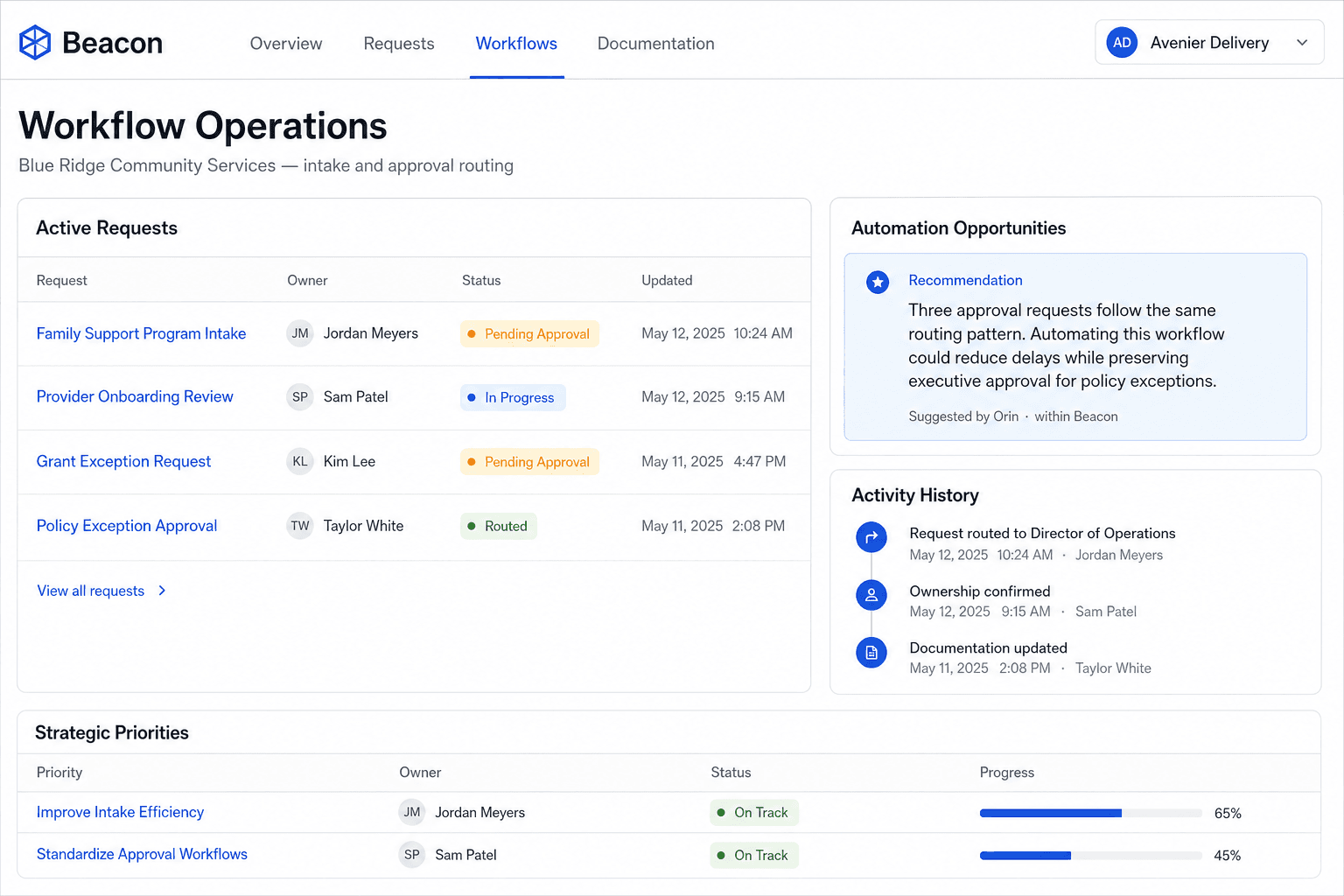
Beacon is Avenier’s internally developed operating platform. It brings workflows, decisions, ownership, documentation, and follow-through into one coordinated environment—and demonstrates how we translate complex operational needs into practical, maintainable systems.

  1. Workflow
  2. Ownership
  3. Intelligence
  4. Review
Beacon workflow operations view showing active requests, ownership, status, activity history, and an operational recommendation for a fictional organization.

Beacon is one example of how Avenier turns organizational complexity into a focused operational system.

Ready to move with more clarity?

Begin a conversation about Software Development & Automation — as an invested partner for the decisions ahead, not a temporary advisor.

Start a Conversation